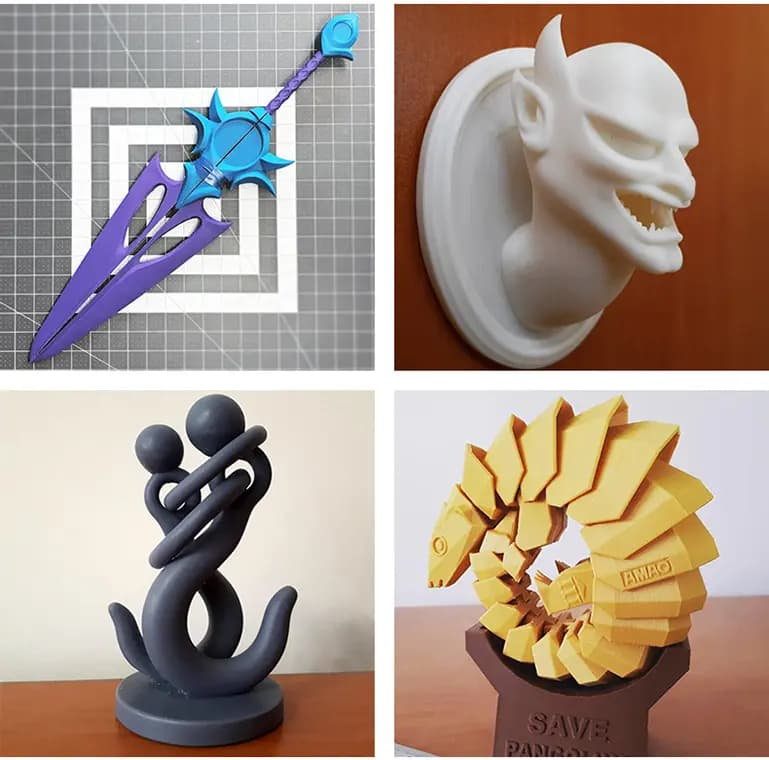
ABS plastic is a common material used in 3D printers, as it is cheap, strong, has high stability, and can be post-processed in various ways (sanding, painting, gluing, filling, and chemical smoothing). When being used in a 3D printer, ABS is known to warp due to the shrinkage that occurs while cooling during the printing process. The shrinking can be reduced by printing inside an enclosure on a heated print surface, using an adhesive such as a glue stick or hairspray to ensure the first layer of the print is well stuck to the print surface, or printing with a brim/raft at the base of the print to help increase adhesion to the print surface. ABS is only used in FFF/FDM 3D printers, as resin 3D printers can not melt plastic.
| Filament Properties Table | |
|---|---|
| 3D PRINTING FILAMENT | ABS |
| Density(g/cm3) | 1.04 |
| Heat Distortion Temp(℃,0.45MPa) | 78 |
| Melt Flow Index(g/10min) | 12(220℃/10kg) |
| Tensile Strength(MPa) | 43 |
| Elongation at Break(%) | 22 |
| Flexural Strength(MPa) | 66 |
| Flexural Modulus(MPa) | 1177 |
| IZOD Impact Strength(kJ/㎡) | 29 |
| Durability | 8/10 |
| Printability | 8/10 |
| Recommended printing parameters | |
| Extruder Temperature(℃) | 230 – 270℃ Recommended temperature:240℃ |
| Bed temperature(℃) | 95 – 110°C |
| Fan Speed | 0% |
| Printing Speed | 40 – 100mm/s |
| Heated Bed | Required |
| Recommended Build Surfaces | High temperature tape, PVP solid glue |
| Feature | |
| Flexible | —— |
| Elastic | —— |
| Impact Resistant | √ |
| Soft | —— |
| Composite | —— |
| UV Resistant | —— |
| Water Resistant | —— |
| Dissolvable | —— |
| Heat Resistant | √ |
| Chemically Resistant | —— |
| Fatigue Resistant | —— |
| Need drying | —— |
| Heated Bed Required | √ |
| Print recommend | Print in an enclosed space, minimize the overhang angle structure in the model |