













SLS vs HP MJF
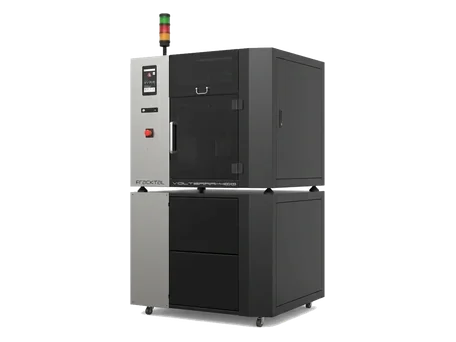
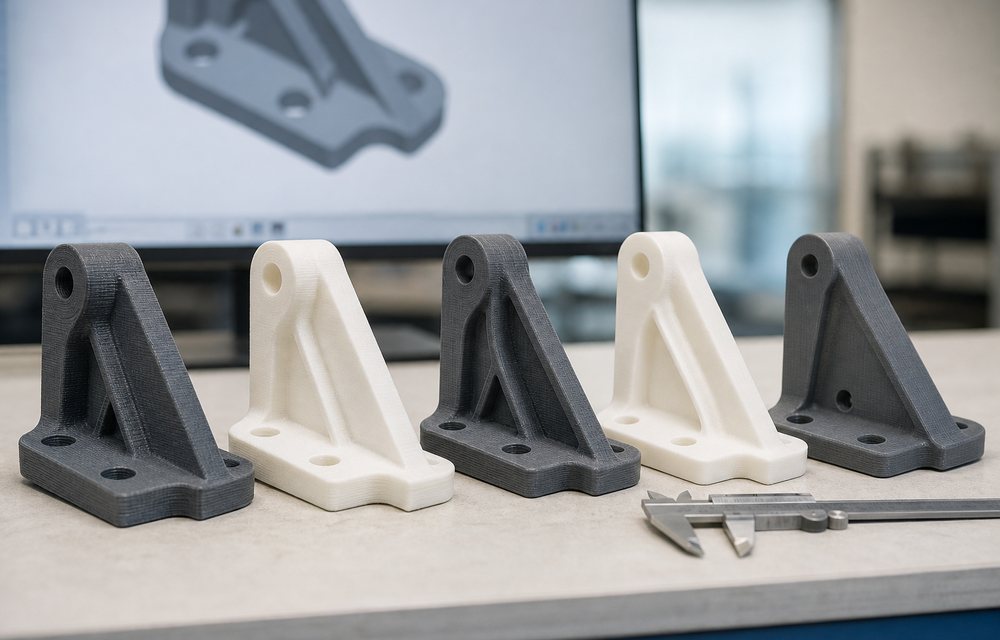
Both fuse nylon powder, both need no support structures, and both give you near-isotropic parts. They are not the same process, and the difference shows up in fine features, surface and how a batch behaves. We build an SLS machine and run MJF as a service, so this comparison has no side to take.

What Each One Does
SLS: a laser sinters the powder
A laser traces each layer into a bed of nylon powder and fuses it. The unfused powder supports the part, so there are no supports to remove and geometry stops being a constraint. Published accuracy ± 0.3 %, 0.1 mm layers, 0.7 mm minimum wall.
MJF: an agent, then heat
A print head lays a fusing agent where the part should be and a heat source fuses the whole layer at once. 0.08 mm layers and a 0.5 mm minimum wall, with a fine matte finish and very even properties across a batch.
The Comparison Table
| SLS | HP MJF | |
|---|---|---|
| Dimensional accuracy | ± 0.3 % | Fine features, even properties |
| Layer thickness | 0.1 mm | 0.08 mm |
| Minimum wall | 0.7 mm | 0.5 mm |
| Surface as made | Uniform matte, granular | Fine matte, light grey |
| Support structures | None | None |
| Strength direction | Near-isotropic | Near-isotropic |
| Material | Nylon 12 | Nylon 12 |
| Best at | One-offs and complex single parts | Batches of small parts with fine detail |
How to Decide
Fine features decide it
If the part has 0.5–0.7 mm walls, thin ribs or small text, MJF holds them where SLS is at its limit.
Batch size decides it
MJF fuses a whole layer at a time, so a full build of small parts is where it earns its place. For one large complex part, SLS is usually the better fit.
Either beats FDM for geometry
Neither needs supports, and both give near-isotropic strength. If your part is failing along layer lines in FDM, both of these fix that.
SLS and MJF Questions
Which is stronger, SLS or MJF?
Do either of them need support structures?
Which is cheaper?
What surface finish do I get?
Can I buy an SLS machine rather than order parts?
Send the Part and We Will Pick
We run both. Tell us the geometry and the quantity and we will tell you which process your part actually wants.