






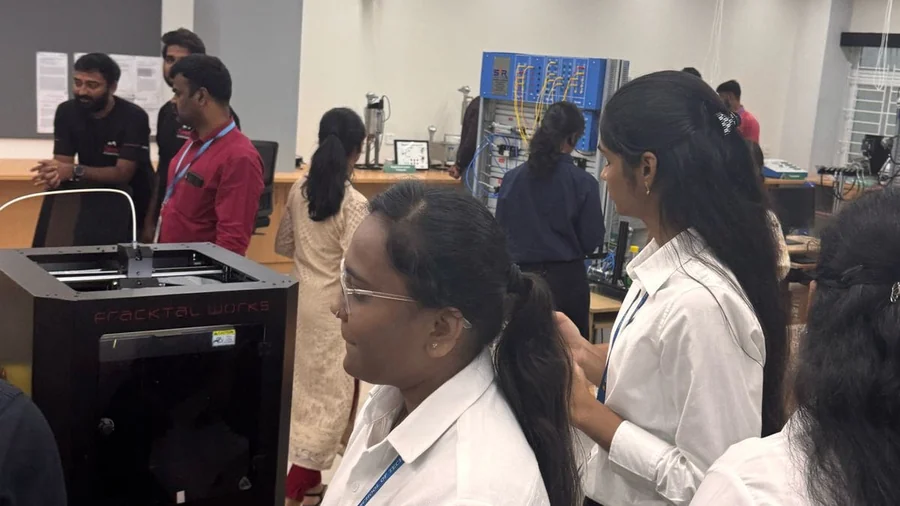

HP MJF 3D Printing
HP’s powder-bed process fuses a whole layer at a time instead of tracing it with a laser. Faster than SLS at volume, finer in detail, and consistent enough to make production parts rather than prototypes of them.
Trusted, recognised and featured











A Whole Layer at Once
MJF spreads nylon powder, then an inkjet array prints two agents onto it — a fusing agent where the part is, and a detailing agent at its edges. An infrared lamp then passes over and fuses the whole layer in a single sweep.
Because the energy is applied across the layer rather than traced along a path, build time depends on how tall the batch is and not on how much is in it. Fill the chamber and the cost per part falls; the detailing agent at the boundary is what keeps the edges crisp while it does.
Where MJF Wins
The powder-bed process to choose when the quantity is real.
Speed at volume
A full chamber fuses in the same passes as a half-empty one. Quantity is what makes MJF cheap.
Sharper small features
The detailing agent controls the melt boundary, so thin walls and small text survive better than in laser sintering.
Consistent properties
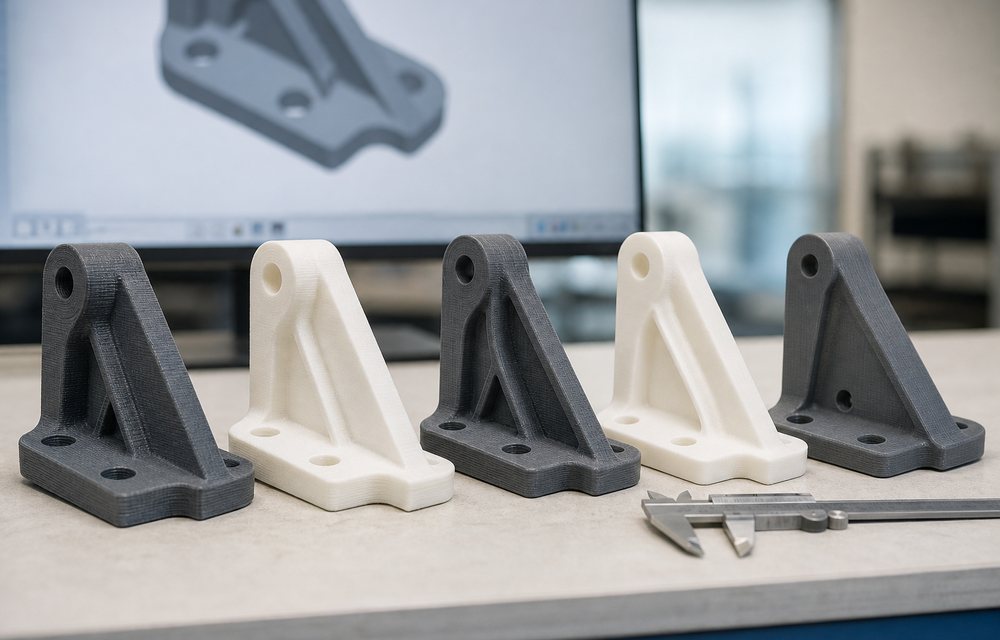
Uniform thermal history across the layer gives repeatable mechanicals from part to part and batch to batch.
Deep, even black
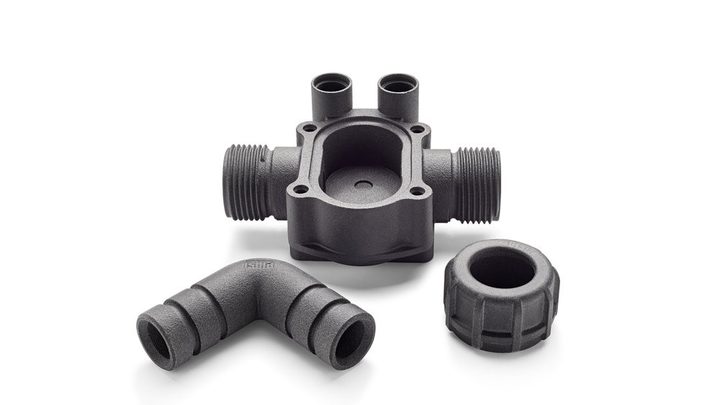
MJF parts finish grey and dye to a uniform black that does not chip the way paint does.
Process Specification
| Parameter | What you get |
|---|---|
| Layer thickness | 0.08 mm |
| Minimum wall thickness | 0.5 mm (0.8 mm recommended) |
| Minimum clearance | 0.4 mm between moving surfaces |
| Escape holes | ≥ 5 mm for enclosed volumes |
| Materials | Nylon 12 (PA12), production grade |
| Finish as printed | Fine matte, light grey |
| Available finishes | Bead blast, dye black, vibro-polish, paint |
| Supports | None — the powder bed supports the part |
| Typical quantities | 10 – 1000 parts |
What People Send Us
Production enclosures
Hundreds of a housing, with the clips and bosses printed in.
Automotive interior parts
Brackets, ducts and trim clips at rates that keep a line moving.
Medical device components
Repeatable properties, batch to batch, with documentation.
Consumer products
Small, detailed, dyed black and shipped in quantity.
Spare-part runs
Obsolete parts made on demand instead of tooled and warehoused.
Bridge production
The volume between prototype and injection tool, without the tool.
Four Steps From File to Part
The same route for every process on this page.
01 · Upload your CAD
Pick a manufacturing process, upload the 3D file and tell us the quantity and finish.
02 · Get a DFM analysis
You get a design-for-manufacturability review with the price.
03 · Manufacturing begins
Approve the quote and the job goes on the floor. You are told when it starts, not only when it ends.
04 · Parts are shipped
Packed, tracked and shipped anywhere in India, with the tracking number in your inbox.
Other Manufacturing Services

FDM 3D Printing
Engineering polymers, one-off to small batch, ±0.5 % accuracy.

SLS 3D Printing
Nylon powder bed, ±0.3 %. No supports, so geometry stops being the constraint.

SLA 3D Printing
Resin, ±0.2 %, for the finest detail and the best surface finish.

Vacuum Casting
Silicone tooling for 1–25 identical cast-polyurethane parts.

Finishing & Assembly
Sanded, blasted, painted, inserted and assembled before it ships.
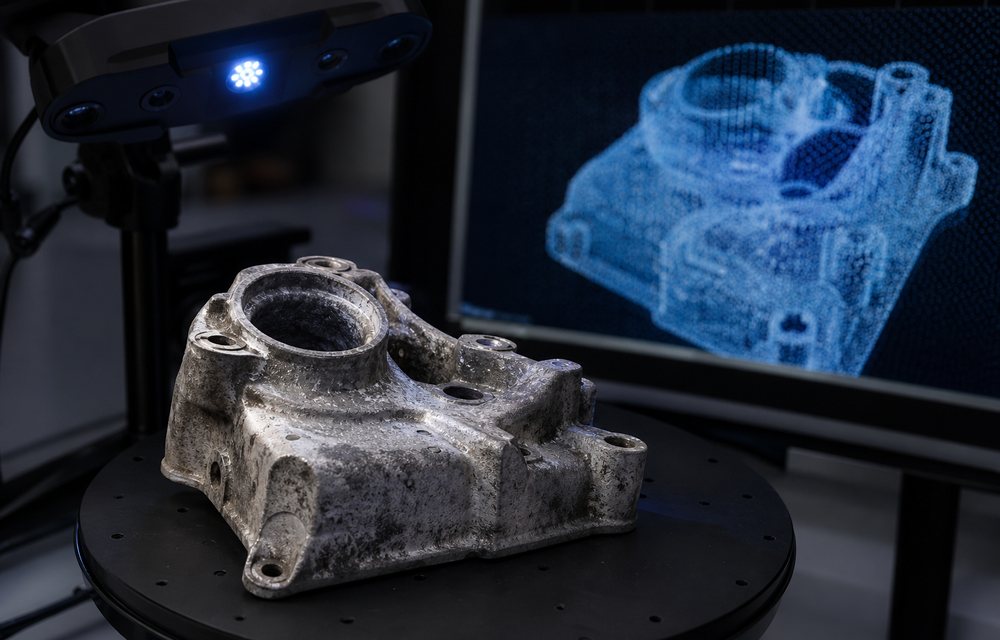
Reverse Engineering
Scan-to-CAD for the part that exists and the drawing that does not.

Quality Assurance
Dimensional and material verification, documented.

Consulting & Design
DfAM, material selection and process design, from CAD to production.
Send us the part
Upload the file and tell us the quantity. What comes back is a price and a design-for-manufacturability review: where the part will give you trouble, and what to change before it does.