











Glue Stick vs Hairspray vs Bed Adhesive
All three work. They differ in what they leave behind, how they behave on a hot plate, and what they do to your build surface over a year. A PVA glue stick is the cheapest thing that works and it is genuinely fine for PLA on glass. Hairspray is a real answer for PET-G and ABS and it coats the whole machine. A purpose-made adhesive costs more per bottle and less per print, and it is the only one of the three designed to release rather than to be scraped.
Fracktal makes one of the three things on this page. That is a reason to read the numbers rather than the adjectives, so every claim below is one you can check on your own machine in an afternoon, and the cases where a ₹40 glue stick is the better buy are named rather than skipped. If you print PLA on glass and nothing else, the honest recommendation on this page is the glue stick.
Three Different Chemistries
PVA glue stick
Polyvinyl acetate or pyrrolidone in a wax carrier, made to stick paper at room temperature. It works on a print bed because PVA is water-soluble and slightly tacky when warm. Cheap, available everywhere, and it goes on unevenly by design — you are rubbing a solid stick across a plate, so the film has ridges and bare patches unless you are careful.
Hairspray
A polymer resin — usually a vinyl acetate or acrylate copolymer — dissolved in alcohol and propellant. It sprays as a thin even film, which is its real advantage, and it bonds well to PET-G and ABS. It also goes everywhere the aerosol reaches: the rails, the belts, the fans and the room. Formulations vary between brands and between years of the same brand.
Purpose-made bed adhesive
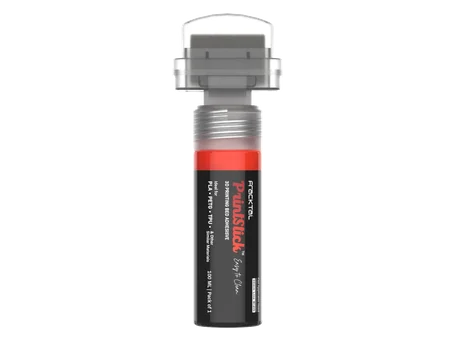
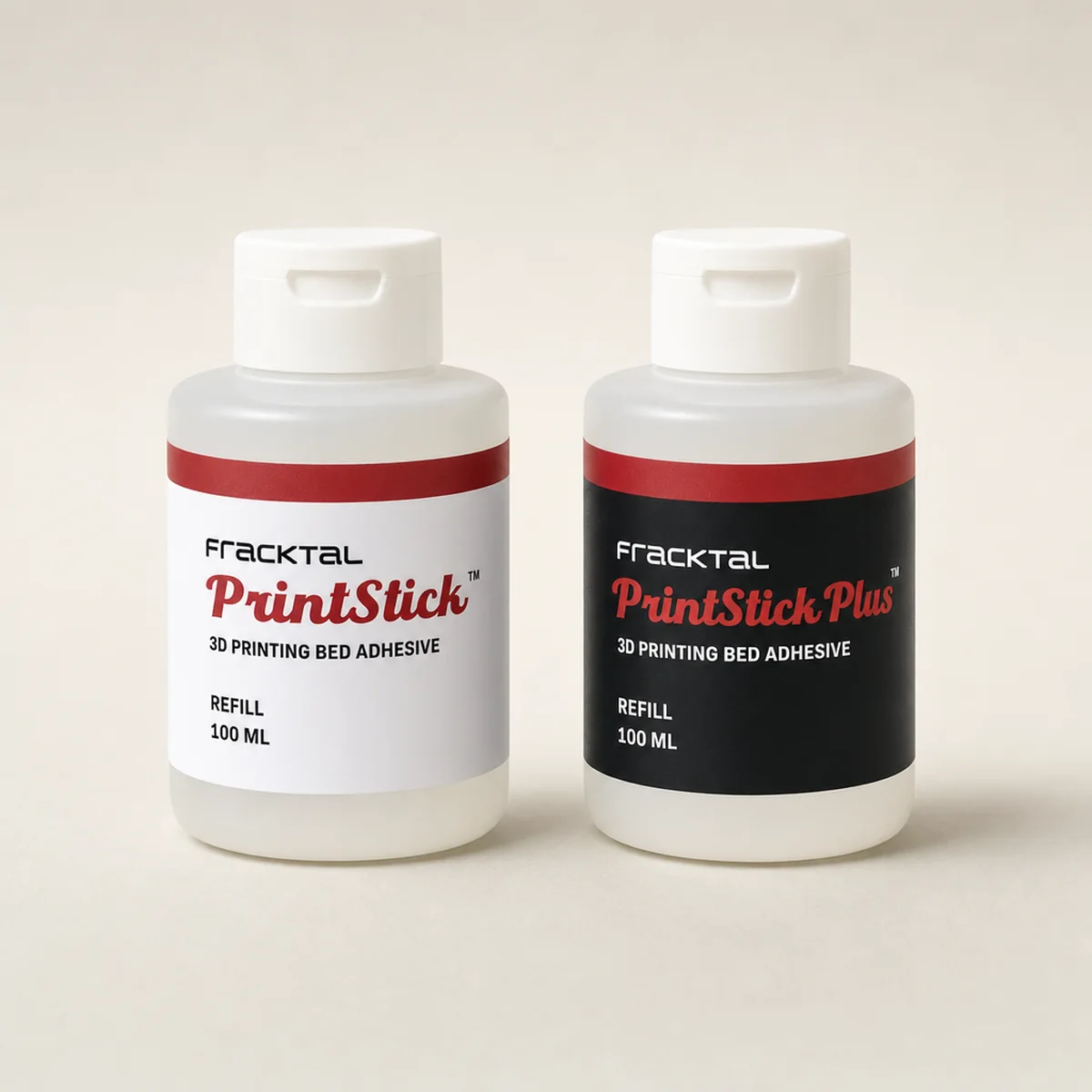
A water-based formulation designed for one job: hold at print temperature, release at room temperature, wash off with water. Applied by a felt head so the film is even and thin. Two formulas because the requirement genuinely splits at about 80 °C of bed temperature — a room-temperature adhesive and a 110 °C adhesive are not the same chemistry.
The Comparison
| PVA glue stick | Hairspray | PrintStick | |
|---|---|---|---|
| Typical price | ₹40–₹120 | ₹250–₹500 | ₹1,199 / ₹1,899 |
| Applications per unit | 30–50 | 100+ | 50+ per 50 ml |
| Cost per print | ₹1–₹3 | ₹3–₹5 | ₹24 / ₹38 |
| Even film | No — ridges and bare patches | Yes | Yes |
| Works above 80 °C bed | Poorly — softens and bakes | Yes | Yes, with the Plus formula |
| Releases as the plate cools | Partly | Partly | By design |
| Removal | Scrape or soak | Alcohol wipe | Damp cloth, water |
| Residue on the part | Visible white film | Slight tack | None |
| Gets on the rest of the printer | No | Yes, unavoidably | No |
| Protects PEI from PET-G | Somewhat | Yes | Yes |
| Consistent between batches | Varies by brand | Varies by brand and year | One formulation |
| Best at | PLA on glass | PET-G and ABS on a budget | Hot plates, engineering materials, farms |
Which One You Should Actually Buy
Buy a glue stick if…
You print PLA, occasionally, on glass or smooth PEI, on a machine you level often. It costs ₹40, it is in every stationery shop, and for that duty it works. The uneven film matters less on a material that barely shrinks, and PVA washes off with warm water. There is no case for spending thirty times more to solve a problem you do not have.
Buy hairspray if…
You print PET-G or ABS, you want an even film, and the cost per print matters more than the mess. Mask the plate and spray it away from the machine — outside, or in another room — because the overspray will otherwise reach the rails and the fans, and dust sticks to it. Expect to strip the build-up with alcohol every few weeks.
Buy a bed adhesive if…
Your bed runs above 80 °C, you print engineering materials, your PEI sheet is worth protecting, or a failed print costs machine hours rather than filament. Also if consistency matters: one formulation, the same result in March and in October, which is not true of a hairspray brand that reformulated between batches.
What PrintStick Costs You
It is the most expensive of the three to buy. ₹1,199 for Standard against ₹40 for a glue stick is a real difference, and one of our own Google reviewers says exactly that — “works very well, recommended to everyone, pricing is a bit on the higher side.” That is a fair criticism and it is on the product page too.
The argument for it is per print rather than per bottle, and it only holds if your prints are worth something. At about ₹24 an application against nine hours of machine time, it is cheap. On a hobby PLA print that takes forty minutes, it is not, and we would rather you bought the glue stick than felt sold to.
There is a middle: a 100 ml refill bottle tops a stick up twice at roughly half the price per millilitre, and a pack of three felt tips is ₹299, so the applicator itself is a one-time cost rather than a recurring one.
Questions About Bed Adhesion Products
Is a glue stick good enough for 3D printing?
Does hairspray actually work for 3D printing?
What is the difference between a glue stick and a purpose-made bed adhesive?
How much does bed adhesive cost per print?
Will any of these damage my PEI sheet?
Can I use PVA glue diluted with water instead?
The Rest of the Guide
- Build plate guideSurface first, product second
- Print not sticking to the bedThe eight causes, in order
- PET-G stuck too wellWhere a release layer is the point
- ABS lifting at the cornersWhere a glue stick stops working
- The full bed adhesion guideEvery cause, every material
- How to clean a build plateThe most-skipped free fix
- Bed temperature by materialAll twelve, in one table
- PrintStick bed adhesiveTwo formulas, 50+ prints a bottle
Built and Tested in Bengaluru
PrintStick was developed on Fracktal’s own machines — Snowflake, Julia, Dragon, Twin Dragon and Volterra — because we needed it before we sold it.