Table of Contents
PLA is the most widely used plastic filament material in 3D printing. Its low melting point, high strength, low thermal expansion, good layer adhesion, and high heat resistance when annealed make it an ideal material for this purpose. Without annealing, however, PLA has the lowest heat resistance of the common 3D printing plastics. But due to its easy-to-print properties, the PLA has dominated the 3D printing industry.
Fracktal uses Esun PLA, called PLA+ which has superior properties and performance compared to standard PLA. Fractal machines are tuned Esun filaments.
| Filament Properties Table | |
|---|---|
| 3D PRINTING FILAMENT | PLA+ |
| Density(g/cm3) | 1.23 |
| Heat Distortion Temp(℃,0.45MPa) | 53 |
| Melt Flow Index(g/10min) | 5(190℃/2.16kg) |
| Tensile Strength(MPa) | 63 |
| Elongation at Break(%) | 20 |
| Flexural Strength(MPa) | 74 |
| Flexural Modulus(MPa) | 1973 |
| IZOD Impact Strength(kJ/㎡) | 9 2/10 |
| Durability | 4/10 |
| Printability | 9/10 |
| Recommended printing parameters | |
| Extruder Temperature(℃) | 210 – 230℃ Recommended temperature:215℃ |
| Bed temperature(℃) | 45 – 60°C |
| Fan Speed | 100% |
| Printing Speed | 40 – 100mm/s |
| Heated Bed | Optional |
| Recommended Build Surfaces | Masking paper, PVP solid glue, PEI |
| Feature | |
| Flexible | —— |
| Elastic | —— |
| Impact Resistant | √ |
| Soft | —— |
| Composite | —— |
| UV Resistant | —— |
| Water Resistant | —— |
| Dissolvable | —— |
| Heat Resistant | —— |
| Chemically Resistant | —— |
| Fatigue Resistant | —— |
| Need drying | —— |
| Heated Bed Required | —— |
| Print recommend | —— |
Selling point: #
Good toughness
strong impact
resistance
High-speed printing
Smooth printed surface
Easy to print
Hard to break
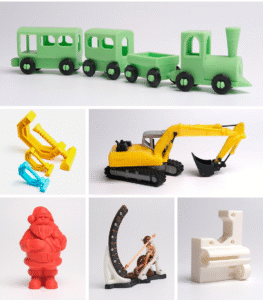
Sample Print images.